Ranges & Rangetops
Viking Range and Rangetop Burner Faults
Burners that will not light, ovens that drift off setpoint, and doors that no longer seal. Sealed burner and oven work on Viking ranges.
Independent Viking kitchen appliances only
Mon–Fri, 8am–6pm Sat, 9am–4pm
Shop Note 003
Spark, gas, path. A burner that keeps clicking without lighting is missing one of the three, and it is usually the cheapest one.
Posted
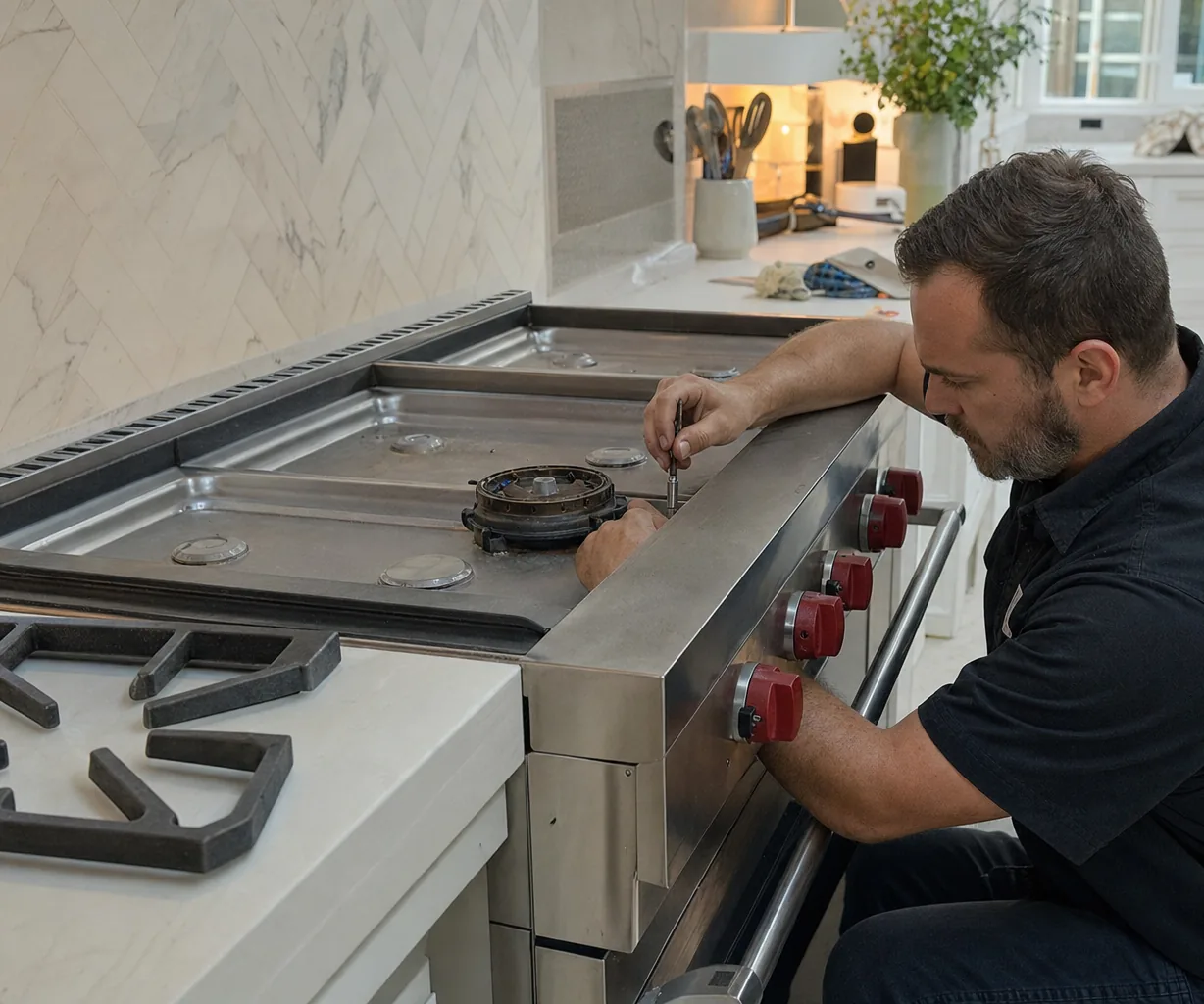
Spark ignition is a simple idea. A switch in the knob tells a module to fire an electrode, the electrode jumps an arc to the burner head, gas arrives, and the arc lights it. Three things have to be true: there must be a spark, there must be gas, and there must be a clear path between them.
When a burner clicks and never catches, one of those three is missing. Finding out which one takes minutes and saves a lot of money.
The single most common cause is the burner cap sitting slightly out of position after a cleaning. These caps locate on a small register and they look seated when they are not. A cap that is a couple of millimeters proud lifts the flame path away from the electrode, and the spark lands on nothing.
Lift it, look at the register, set it down properly, try again. That is free and it fixes a genuinely surprising share of calls. We do it first and we tell customers to do it first, even though it means some calls end without a repair.
The crown of a sealed burner has a ring of ports, and the flame has to carry around that ring from the one nearest the electrode. Boil-over, carbon and cleaning-product residue block ports. When the ports next to the electrode are blocked, the spark is jumping into a gap where no gas is emerging.
The symptom that gives this away is a burner that lights only when you turn it to high, or one that lights and then drops out as soon as you turn it down. Both are the flame failing to carry.
Ports clear with a fine wire and patience. Never a drill bit — opening a port oversize changes the flame character permanently and cannot be undone.
The electrode has a ceramic insulator and a tip, and it needs a defined gap to the burner head. Three things go wrong. The tip gets fouled with cooked-on spill, so the arc is weak or intermittent. The ceramic cracks, so the spark tracks to ground somewhere it should not and never reaches the gap. Or moisture has got into the assembly — which in a Florida kitchen after a boil-over is not rare — and the spark shorts until it dries out.
A cracked ceramic is a replacement. A fouled tip is a clean. Moisture is a matter of leaving it alone for a few hours, which is advice worth having before paying for a call-out.
If every electrode on the range fires whenever any one knob is turned, that is the ignition module behaving as designed on many appliances, or a module with a shorted channel. It is loud and it is alarming and it is almost never dangerous. It is also the thing most likely to get a module replaced unnecessarily.
We test the module channel by channel with the switches disconnected. If it is dead, it gets replaced. If it is not, it does not, no matter how dramatic the noise is.
If there is a good spark, clear ports and a correctly seated cap, and the burner still will not light, the problem is gas delivery — a valve, a regulator, or supply pressure. We diagnose that and we replace appliance valves. We do not run new gas line and we do not adjust meter-side regulators. That is a licensed trade and it should be.
Anyone who smells gas persistently should shut the supply off at the appliance and call the gas utility before they call us. That order is not negotiable and it is not a repair we would ever try to get ahead of.
Cap, ports, electrode, module, gas. Cheapest and most likely first, most expensive and least likely last. Working the other way round is how people end up with a new ignition module on a range whose only problem was a burner cap that was not sitting down.
Flat diagnostic, credited toward the repair. Written estimate before any part is ordered.
What it costs
The visit and the whole diagnostic sequence are $80 flat, and that comes off the bill the moment you approve the work. Repairs of this kind have run $200–$530 in parts and labor after that, and the figure on your estimate is written down before a part is ordered.
| Work | Parts and labor |
|---|---|
| $80 diagnostic | Flat, credited toward the repair |
| Igniter or burner assembly | $200–$530 |
A band is where the work has landed, not a quote. You get a written estimate before any part is ordered or any tool comes out. 90 days on labor, 365 days on parts. The whole table is on the pricing page.
Asked on the phone
Related
Ranges & Rangetops
Burners that will not light, ovens that drift off setpoint, and doors that no longer seal. Sealed burner and oven work on Viking ranges.
Sector 32207
1920s kitchens, openings narrower than the appliance, and counter circuits that were never dedicated. Fitting work first, parts work second.
Sector 32205
A professional range in a bungalow kitchen built before the appliance existed. Long duct runs, shared circuits, and floors that have moved for a century.
Sector 32210
A 1900s–1930s peninsula neighborhood where condenser fins, hinge pins and levelling hardware age faster than the same parts four miles inland.
What customers said
4.3 out of 5, across 77 published customer reviews. Read every one of them.
The griddle would not get past warm. He checked the burner beneath first, then found the flame spreader cracked through and sitting off its seat. Swapped it and the plate heats evenly corner to corner now.
Rosalind E.
The oven under the rangetop would not hold a low temperature through a long braise. He calibrated it against his own probe and found the bake element cycling early. It holds within a few degrees now.
Wilfred N.
Every burner sparked whenever I turned one knob, which is unsettling in a house this old. He found moisture tracking across the switch block, dried it out and replaced it, and only the chosen burner lights.
Marisol D.
Book the visit
Viking only. Duval County, citywide. Flat $80 diagnostic. It is credited toward the repair if you approve the work.