Sector 32256
Viking Hood Starved of Air in Deerwood
Late-model southside houses built tight, where a big blower has nowhere to draw make-up air from and one kitchen carries five separate systems.
Independent Viking kitchen appliances only
Mon–Fri, 8am–6pm Sat, 9am–4pm
Undercounter & Wine
Wine cabinets drifting off setpoint, beverage centers icing up, and undercounter ice machines skipping harvests. Small boxes in very tight spaces.
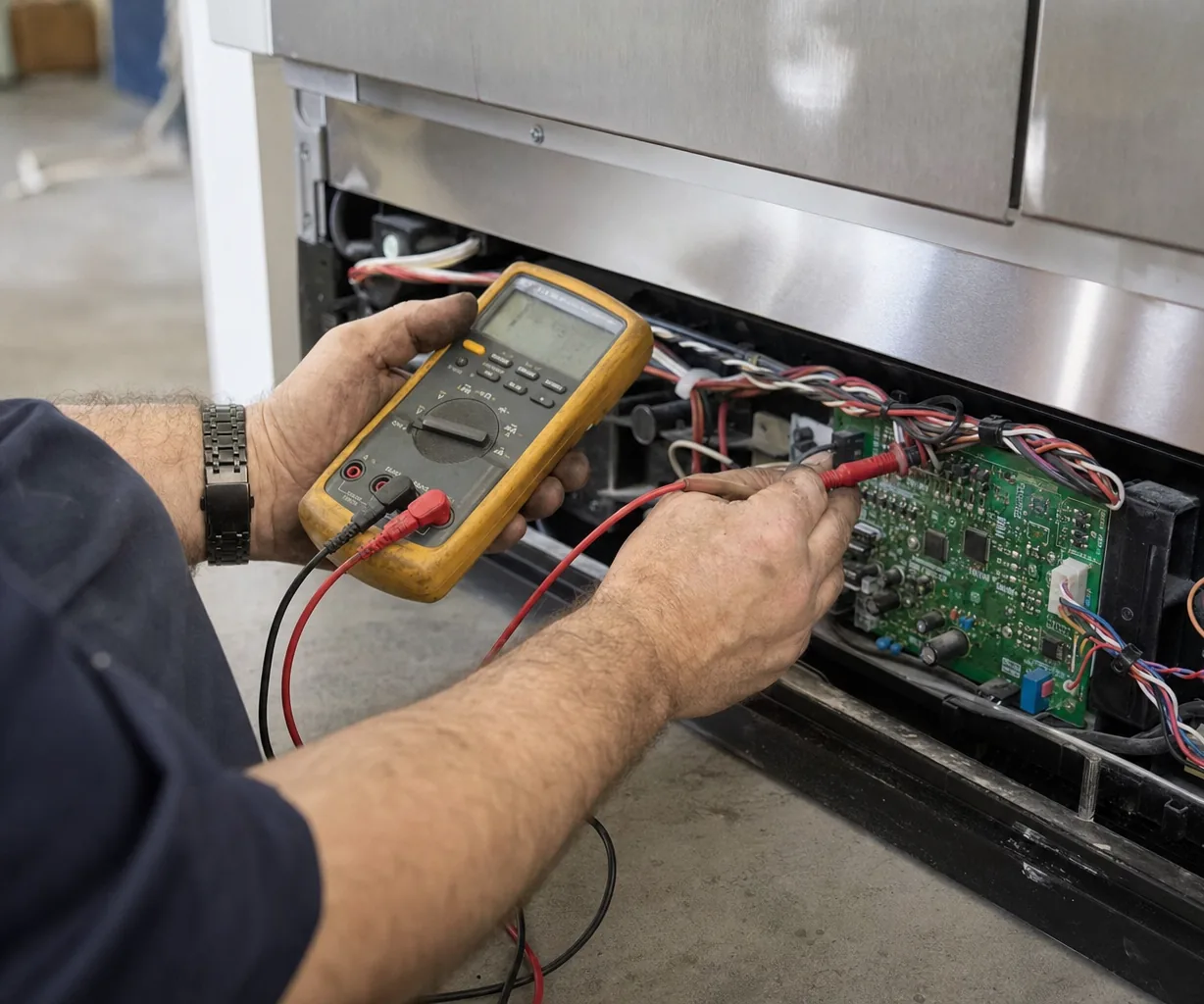
Symptoms we get called for
Undercounter refrigeration is a full refrigeration system squeezed into a fifteen-inch or twenty-four-inch box that has been slid into a cabinet with almost no clearance. Everything that makes a full-size unit forgiving — mass, airflow, spare condenser area — has been designed out to make it fit. That is why these units fail differently.
An undercounter unit rejects its heat through a small condenser, usually front-breathing through a toe grille. When that grille is blocked by a kick panel that was fitted a little too tight, or the coil behind it is furred with dust, the machine cannot get rid of its heat and the cabinet face gets warm. In a Jacksonville summer, with a kitchen already running warm, that is enough to push a wine cabinet three or four degrees above setpoint and keep it there.
Owners usually describe this as the unit losing its charge. It rarely is. The first thing we do is pull the grille, look at the coil, and check whether the condenser fan is actually turning. That check has ended a lot of expensive conversations early.
Wine storage cares less about hitting a number than about holding one. Bottles have thermal mass and they do not notice a short excursion, but a cabinet that swings several degrees every cycle is doing real work on the corks over years. When a dual-zone cabinet holds one zone and loses the other, the shared parts — compressor, condenser, charge — are proven working by the zone that is fine. The fault is in that zone’s damper, fan or sensor.
Vibration matters as well. A compressor mount that has hardened transmits every start into the cabinet and through the racks. It is not a fault the machine will report, and it is one of the few things worth fixing purely for the sake of what is stored inside.
An undercounter ice machine is the hardest-working appliance in the house per cubic foot, and it fails in stages rather than all at once. Cubes get smaller and hollow first, because the water film is no longer freezing evenly across the plate. The harvest cycle gets longer next, because the mold has to be warmed through before ice will release, and that longer harvest warms the compartment a little more on every batch. Then the machine starts skipping harvests entirely and the bin never fills.
We work that backwards from the water in. The inlet valve and its screen come first, then the distribution tube and the plate surface, then the harvest heater and its thermostat, and the control last. Ice that tastes wrong is almost always a filter that has been in place for years rather than a fault in the machine — inline filters address taste and particulate, and they have a service life measured in months, not in the length of time the owner has lived there.
Drainage deserves a mention of its own here, because an ice machine drains continuously rather than in a cycle. A gravity drain needs continuous fall the whole way to its termination, and a great many undercounter installations do not have it, because the cabinet run was decided before the appliance was chosen. A machine that works in winter and floods in August is often a drain that is only just adequate, not a machine that has developed a leak.
These units are specified with a required air gap and a required ventilation path, and cabinet makers do not always read that page. A front-breathing unit must be able to take air in and push it out through the toe grille, which means the kick panel cannot be flush, the grille cannot be covered by a decorative plinth, and the cabinet cannot be sealed at the back or sides on the assumption that the appliance breathes upward.
When a unit has been built into a sealed opening, no repair will hold. We will say that plainly, in writing, with the clearance figure from the appliance’s own installation instructions, so that the cabinet maker or the builder has something specific to work from. It is a frustrating diagnosis to receive, and it is far cheaper than a second compressor.
Undercounter units drain to a small pan or a pump, and both silt up. A beverage center that ices up at the back is often a defrost drain that has closed rather than a defrost heater that has failed. It is a ten-minute job when it is diagnosed correctly and an expensive one when it is not.
Flat diagnostic, credited toward the repair. Written estimate before any part is ordered. Sealed-system work is done by EPA Section 608 certified technicians. Genuine OEM parts, ninety days on labor and a year on parts.
What it costs
The visit and the whole diagnostic sequence are $80 flat, and that comes off the bill the moment you approve the work. Repairs of this kind have run $240–$2,360 in parts and labor after that, and the figure on your estimate is written down before a part is ordered.
| Work | Parts and labor |
|---|---|
| $80 diagnostic | Flat, credited toward the repair |
| Refrigeration fan or defrost system | $240–$650 |
| Compressor or sealed-system repair | $1,010–$2,360 |
A band is where the work has landed, not a quote. You get a written estimate before any part is ordered or any tool comes out. 90 days on labor, 365 days on parts. The whole table is on the pricing page.
Before you book
Related
Sector 32256
Late-model southside houses built tight, where a big blower has nowhere to draw make-up air from and one kitchen carries five separate systems.
Sector 32207
1920s kitchens, openings narrower than the appliance, and counter circuits that were never dedicated. Fitting work first, parts work second.
Sector 32223
Large kitchens, island hoods on long duct runs, and a lot of refrigeration installed in garages and lanais the house never cools.
Shop Note 001
Smaller cubes first, then a slower harvest, then a valve that will not seat and a sheet of ice on the freezer floor. The order matters more than the part.
Shop Note 007
Most Viking freezer codes are door, temperature or cleaning alarms you can clear, but a sensor code that will not reset needs a technician.
Shop Note 006
Two years covers the whole refrigerator, the sealed system runs longer, and the plate inside the cabinet decides which filter or part is right.
What customers said
4.3 out of 5, across 77 published customer reviews. Read every one of them.
Both zones in the wine unit had drifted toward each other and neither held. He found one evaporator fan dead and the other struggling, replaced both, and the two zones now sit where they are set.
Ezra L.
Condensation kept forming inside the glass door and spotting the labels. He checked the door heater circuit, found it open, and replaced it. He also explained why a humid kitchen makes that fault show up faster.
Solomon K.
Our wine cabinet had crept several degrees above its setting and stayed there right through the summer. He cleaned a filthy condenser, replaced the fan behind it, and it has held where we set it since.
Alaric W.
Book the visit
Viking only. Duval County, citywide. Flat $80 diagnostic. It is credited toward the repair if you approve the work.