Sector 32256
Viking Hood Starved of Air in Deerwood
Late-model southside houses built tight, where a big blower has nowhere to draw make-up air from and one kitchen carries five separate systems.
Independent Viking kitchen appliances only
Mon–Fri, 8am–6pm Sat, 9am–4pm
Built-In Refrigeration
Warm boxes, iced-up evaporators, noisy condenser fans and doors that no longer pull shut. Built-in and freestanding refrigeration.
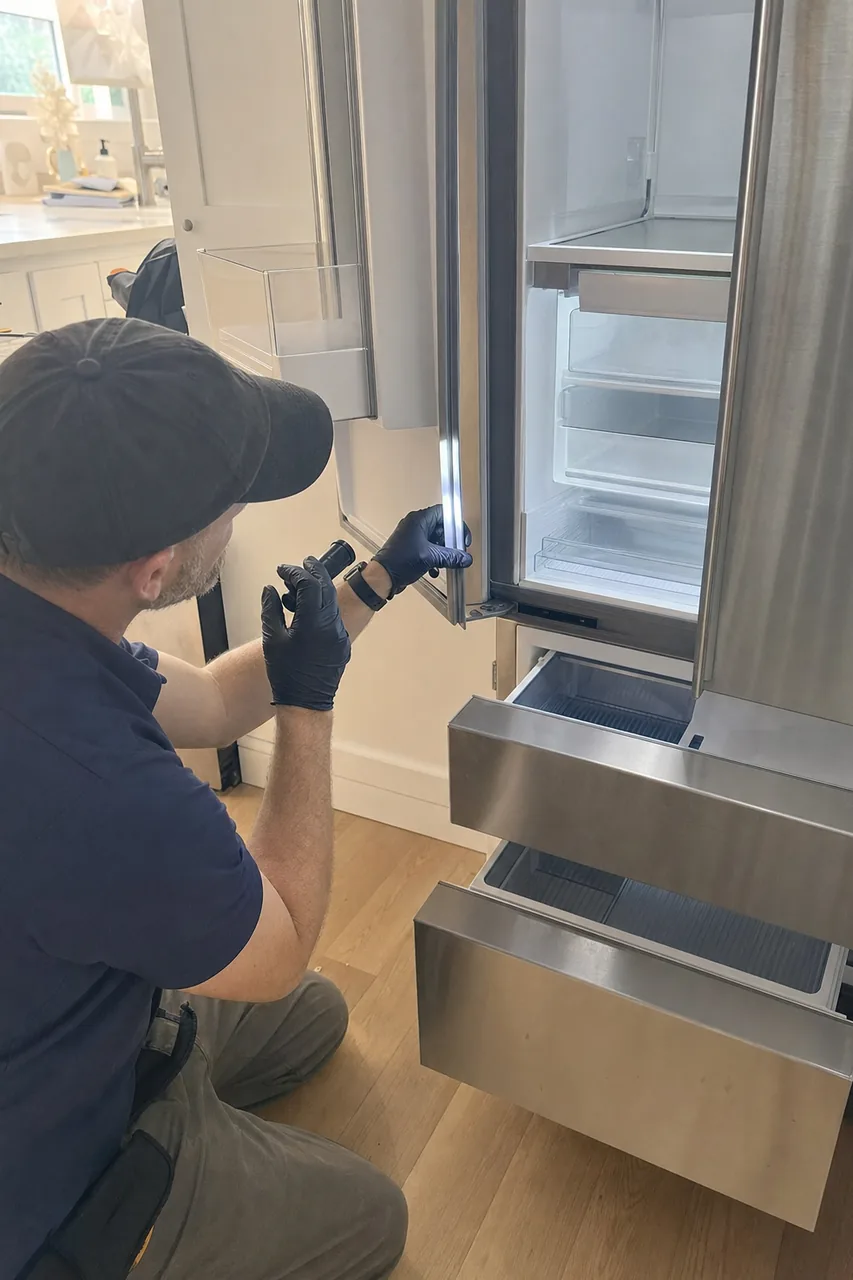
Symptoms we get called for
Refrigeration is the one part of a kitchen that never gets a night off. A built-in unit runs every hour of the year in a house where the ambient temperature outside the cabinet is high for six months of it. Jacksonville summers push condensers harder than the design case, and that is why the failure pattern here is not the same as it is in a cool climate.
The most common call we take is a fresh food compartment that has gone warm while the freezer is still making ice. That combination is diagnostic in itself. If the freezer is cold, the sealed system is producing refrigeration, so the compressor and the charge are probably fine. The problem is air movement: an evaporator fan that has stopped, a damper that is stuck shut, or an evaporator coil so packed with frost that no air can get through it.
Frost that keeps coming back after a manual defrost points at the defrost circuit — the heater, the terminating thermostat, or the control that decides when to run it. That is a repair. A one-time frost-up after someone left the door ajar overnight is not.
When the sealed system genuinely is the problem — a restriction, a leak, a compressor that will not start against pressure — that is refrigerant work, and it is done by technicians holding EPA Section 608 certification. That credential is the law for recovering and handling refrigerant, and it is one of the few things we will claim, because it is genuinely held.
We are also honest about when sealed system repair is not worth doing. On a built-in unit with a healthy cabinet and good doors it usually is. On a fifteen-year-old freestanding unit with a leaking evaporator, it usually is not, and we will say so rather than take the job.
Duval County reaches the ocean. Houses on the beaches side of the county sit in salt air, and salt air eats aluminum condenser fins and steel hinge pins. A condenser that has lost half its fin area to corrosion cannot reject heat, so the compressor runs longer, the box drifts warm on hot afternoons, and the compressor eventually fails from duty cycle rather than from any defect.
Inland — Deerwood, Baymeadows, Mandarin, San Marco — the equivalent problem is dust and pet hair blocking the same coil. The mechanism is different, the result is identical, and both are prevented by pulling the grille once a year and actually cleaning behind it.
Water under the crisper drawers is almost always a blocked defrost drain, not a leak. The drain ices over, meltwater backs up, and it finds the lowest point in the liner. Clearing it takes minutes. Diagnosing it as a door seal costs money and fixes nothing.
Water at the back of the freezer floor, or a column of ice down the back of the bin, is the ice maker rather than the drain. The order there is the fill tube first — a partly frozen fill tube produces small cubes and overflow and costs nothing to rule out — then the fill valve and its screen, then the mold and the harvest heater, and the control last. Replacing a control because an ice maker is behaving oddly is one of the most common wasted repairs in this trade.
Almost everything worth diagnosing on a built-in is at the back or under the front grille, and neither is reachable with the unit in place. A built-in refrigerator is heavy, it is trimmed into the cabinetry, and it is usually tethered by a water line and a cord that between them decide how far forward it can come. Column units and full-height models often ride on a frame rather than on castors, and the toe grille and top trim have to come off in the right order or the panels mark.
We ask about three things before we arrive: whether the appliance carries custom cabinet panels, what the flooring is in front of it, and whether the counter overhangs the case. Those answers decide whether the job needs a second technician and whether the floor needs protecting first. It is also worth knowing that a built-in wants its own circuit; a shared branch that trips under a defrost cycle looks exactly like an intermittent control fault and is not one.
A built-in door is heavy and it is expected to self-close from a few degrees open. When it stops doing that, the cam or the closer spring has worn, or the unit has shifted on its levelling feet and is no longer sitting back-heavy. Condensation along the frame in August is usually the same story: a door that is touching everywhere except one short run of gasket.
Flat diagnostic, credited toward the repair. Written estimate before any part is ordered. Genuine OEM parts, ninety days on labor, a year on parts.
What it costs
The visit and the whole diagnostic sequence are $80 flat, and that comes off the bill the moment you approve the work. Repairs of this kind have run $240–$2,360 in parts and labor after that, and the figure on your estimate is written down before a part is ordered.
| Work | Parts and labor |
|---|---|
| $80 diagnostic | Flat, credited toward the repair |
| Refrigeration fan or defrost system | $240–$650 |
| Compressor or sealed-system repair | $1,010–$2,360 |
A band is where the work has landed, not a quote. You get a written estimate before any part is ordered or any tool comes out. 90 days on labor, 365 days on parts. The whole table is on the pricing page.
Before you book
Related
Sector 32256
Late-model southside houses built tight, where a big blower has nowhere to draw make-up air from and one kitchen carries five separate systems.
Sector 32207
1920s kitchens, openings narrower than the appliance, and counter circuits that were never dedicated. Fitting work first, parts work second.
Sector 32210
A 1900s–1930s peninsula neighborhood where condenser fins, hinge pins and levelling hardware age faster than the same parts four miles inland.
Sector 32223
Large kitchens, island hoods on long duct runs, and a lot of refrigeration installed in garages and lanais the house never cools.
Shop Note 001
Smaller cubes first, then a slower harvest, then a valve that will not seat and a sheet of ice on the freezer floor. The order matters more than the part.
Shop Note 007
Most Viking freezer codes are door, temperature or cleaning alarms you can clear, but a sensor code that will not reset needs a technician.
Shop Note 005
A board that died during a storm and a board that has been getting stranger for months are two different repairs. The history matters.
Shop Note 006
Two years covers the whole refrigerator, the sealed system runs longer, and the plate inside the cabinet decides which filter or part is right.
What customers said
4.3 out of 5, across 77 published customer reviews. Read every one of them.
Our second box lives in the garage and it was running without ever stopping. Nothing had failed. The coil was matted with lint and the room was brutal, so he cleaned it and set my expectations for August.
Augustin B.
The ice maker filled but never dropped a cube. He warmed the mould, watched one harvest cycle right through, and traced it to the ejector motor rather than the valve everyone told me it would be.
Cordelia B.
The door alarm kept sounding when nobody was near it. A sagging gasket on the left side was breaking the seal just enough. He fitted a new one, checked the closer, and the kitchen is quiet at night.
Thaddeus R.
Book the visit
Viking only. Duval County, citywide. Flat $80 diagnostic. It is credited toward the repair if you approve the work.