Ranges & Rangetops
Viking Range and Rangetop Burner Faults
Burners that will not light, ovens that drift off setpoint, and doors that no longer seal. Sealed burner and oven work on Viking ranges.
Independent Viking kitchen appliances only
Mon–Fri, 8am–6pm Sat, 9am–4pm
Shop Note 002
A display is not a measurement. Put a probe on the middle rack and watch a full cycle before anyone orders a part.
Posted
The call usually arrives as a baking complaint. Cookies burn on the bottom. Bread does not rise the way it used to. A roast takes forty minutes longer than the recipe says. Somewhere in the conversation the owner says the oven is possessed.
It is not possessed. It is drifting, and drift is measurable.
The number on the front of an oven is what the control believes, and what the control believes comes from one resistance sensor hanging in the cavity. If that sensor is reading high, the control shuts the heat off early and the oven runs cold while the display insists everything is fine. If the sensor reads low, the opposite. Either way the display and the reality have separated, and no amount of staring at the panel will tell you by how much.
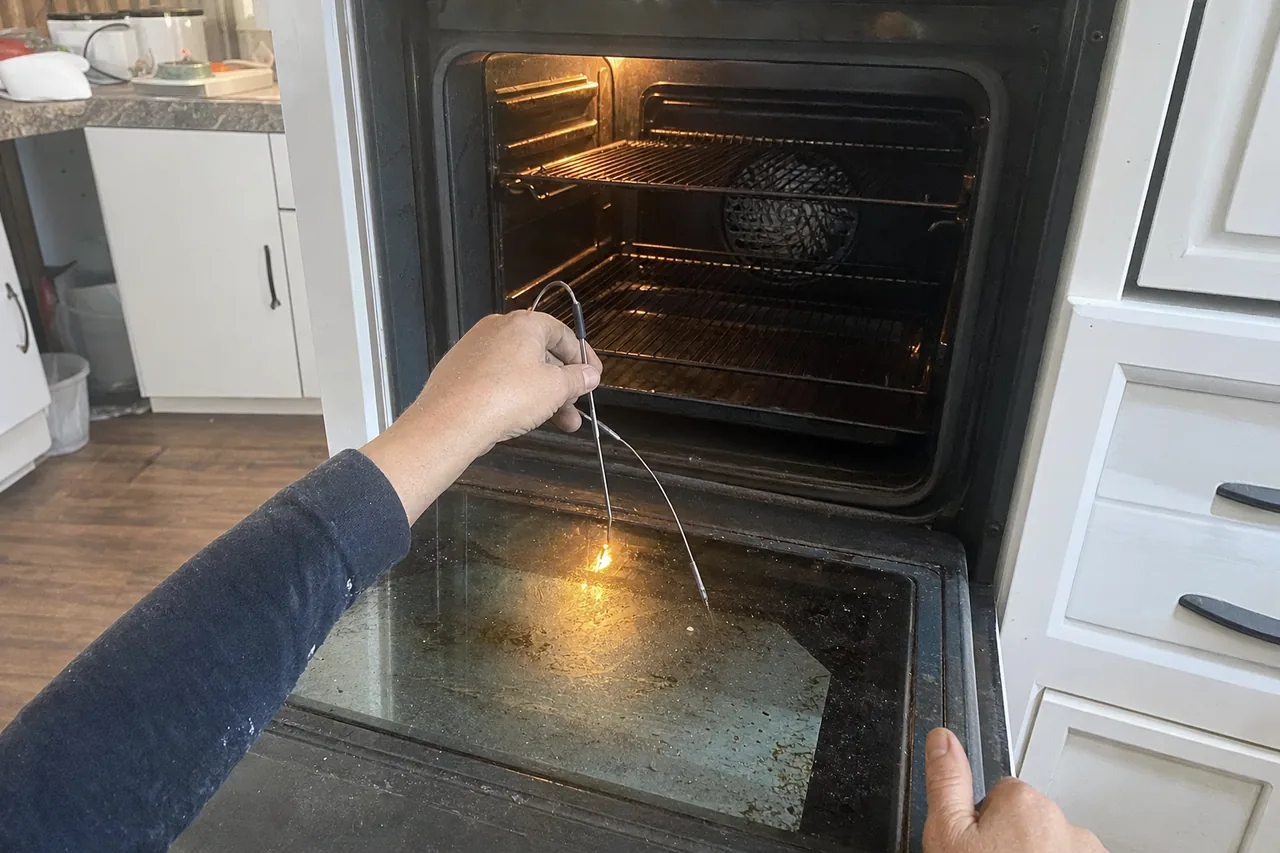
So the first thing that comes out of the bag is a probe, not a screwdriver. We put a thermocouple on the middle rack, set a target, and watch a full cycle — not the moment the preheat beep sounds, but three or four complete on-off swings after that.
A healthy oven overshoots its setpoint slightly, falls back, and swings within a narrow band around the target. That is normal and it is what the control is designed to do.
An oven that is uniformly twenty or thirty degrees off in one direction, but swinging normally, is a calibration problem. Most electronic controls have an offset adjustment for exactly this, and using it is a five-minute job with no parts at all. An eight-year-old oven reading twenty-five degrees low is behaving its age, not failing.
An oven that swings wildly — big overshoot, long undershoot, no settled band — is a sensor or a relay problem, not a calibration one. The control is getting bad information or acting on it late.
An oven that climbs slowly and never gets to the target at all is usually an element that has partially opened, or a sensor reading high enough that the control keeps cutting the heat. A resistance check across the element terminals separates those two in about ten seconds.
Oven temperature sensors are resistance devices with a known value at room temperature. Pull the connector, put a meter across it in a cold cavity, and the reading either sits where it should or it does not. It is one of the few tests in this trade that gives a plain yes or no with no interpretation required.
We do that before we ever discuss a control board, because a board is the most expensive part in the machine and the least likely to be the fault.
Drift is about the whole cavity being at the wrong temperature. Browning on one side while the other stays pale is about air, not heat. On a convection oven that means the fan is turning but not moving air properly, or a baffle behind the fan is loose or missing. On a conventional oven it usually means the door is not sealing evenly, which in an older Riverside or San Marco kitchen frequently traces back to a floor that is not flat rather than a hinge that is worn.
We put a level on the floor in those houses. It sounds like an odd thing to do on an oven call. It has explained a lot of crooked doors.
A calibration costs a diagnostic. A sensor is an inexpensive part and a short labor job. A control board is neither. Working in that order means most temperature complaints end at the first or second step, and the customers who genuinely do need a board get one after we have proved it rather than assumed it.
Flat diagnostic, credited toward the repair if you approve the work. Written estimate before anything is ordered. Genuine OEM parts.
What it costs
The visit and the whole diagnostic sequence are $80 flat, and that comes off the bill the moment you approve the work. Repairs of this kind have run $200–$970 in parts and labor after that, and the figure on your estimate is written down before a part is ordered.
| Work | Parts and labor |
|---|---|
| $80 diagnostic | Flat, credited toward the repair |
| Oven thermostat or heating element | $200–$570 |
| Control board or touch panel | $410–$970 |
| Igniter or burner assembly | $200–$530 |
A band is where the work has landed, not a quote. You get a written estimate before any part is ordered or any tool comes out. 90 days on labor, 365 days on parts. The whole table is on the pricing page.
Asked on the phone
Related
Ranges & Rangetops
Burners that will not light, ovens that drift off setpoint, and doors that no longer seal. Sealed burner and oven work on Viking ranges.
Wall Ovens
Elements that open up, sensors out of range, and doors that will not stay square. Single and double wall ovens, built in.
Sector 32205
A professional range in a bungalow kitchen built before the appliance existed. Long duct runs, shared circuits, and floors that have moved for a century.
Sector 32223
Large kitchens, island hoods on long duct runs, and a lot of refrigeration installed in garages and lanais the house never cools.
What customers said
4.3 out of 5, across 77 published customer reviews. Read every one of them.
The griddle ran hotter at one end than the other and my breakfast proved it every weekend. He got underneath, found a tube partly blocked, cleared it and checked both ends with a meter before packing up.
Emmett D.
The oven under the rangetop ran cold by a wide margin. He measured the sensor resistance cold and again hot, showed me both numbers, and changed it. Baking times went back to what the recipes actually say.
Warren S.
Work was done properly and the range is fine. What I would flag is that the first diagnosis missed a second failed igniter, so we had a follow-up visit for something that could have been caught in one.
Julius O.
Book the visit
Viking only. Duval County, citywide. Flat $80 diagnostic. It is credited toward the repair if you approve the work.